
Contents
Practical steps for reviewing employment contracts and probation before 1 January 2027
23 November 2026 | England, Scotland and Wales
From 1 January 2027, the qualifying period for ordinary unfair dismissal protection falls from two years to six months. For employers, the practical task is to make sure employment contracts, probation arrangements and everyday management work together.
Most employers let probation periods pass with little to no thought. A diary reminder at the end of probation leaves little room for an employee or an employer to understand a concern, provide support and assess improvement. You should use the weeks before January to review the documents you already use and give managers a clear process to follow, ensuring that any performance concerns are reviewed and actioned early. The new rule will come into effect whether you are prepared or not so it is important to ensure you have all systems in place to protect yourselves against a claim.
For background, see LAW365’s earlier article, Preparing for a Six-Month Unfair Dismissal Qualifying Period. This follow-up focuses on the practical steps employers can take ahead of 1 January 2027.
What changes in January
The new rule applies to all employees in the business, not just those who you engage from the date of the change. From 1 January 2027, ordinary unfair dismissal protection will cover employees with at least six months' continuous service.
The qualifying period for requesting written reasons for dismissal also falls to six months, and the statutory cap on unfair dismissal compensatory awards will be removed. Compensation will still depend on evidenced loss but the potential is now there for awards to be increased. These changes apply in England, Scotland and Wales; Northern Ireland has separate rules.
What steps do I need to take?
Review the people already on your payroll
Start with existing staff as well as planned recruits. Record each employee's continuous service date, contractual probation end date, notice terms, next review meeting and any outstanding support needs. Include fixed-term employees: the expiry of a fixed-term contract without renewal counts as a dismissal for these purposes.
Check existing contracts and the templates still being issued
Review your current employment contract templates and review your procedures and how your managers deal with underperformance in probation. Check the following points.
- Probation: is the duration clear, and does the wording explain how completion and any extension will be confirmed? Does the length of any probation and possible extension align with the new six-month qualifying period?
- Extensions: are the conditions clear, and do the contract and any policy describe a workable process?
- Notice: do the probation and post-probation notice clauses work together, including any payment-in-lieu provision?
- Policies: do probation, capability, disciplinary and dismissal procedures give consistent instructions?
- Authority: who can confirm probation, approve an extension or make a dismissal decision?
- Management: do managers know what is in the contract terms and what they need to do if someone is underperforming?
The reform does not mean every contract needs replacing. Instead you should ensure that changes are actually needed and take advice where you are uncertain or unsure how to go about changing or altering your contractual or policy documents.
Diarise probationary review meetings
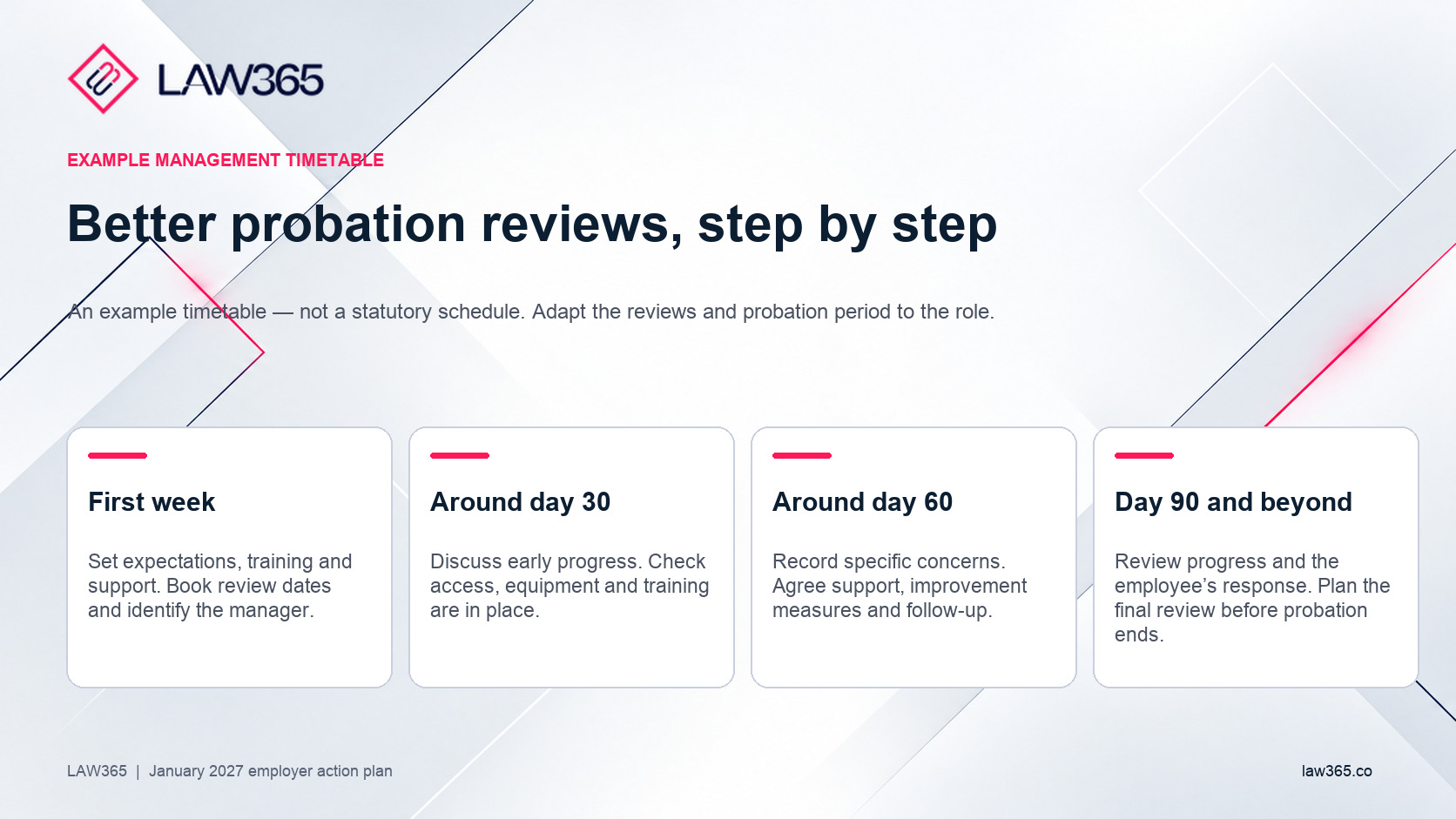
Use regular conversations to assess progress and ensure that the employee is given the chance to respond, understand how they may be underperforming and are clear on how they could improve. The following is an example management timetable, this is not a statutory schedule or a recommendation that every probation should last three months. Employers should adapt the probationary period to the role and consider practically how long they need to adequately assess performance.
| When | Practical action |
|---|---|
| First week | Agree role expectations, training and support. Book the review dates and identify the manager responsible. |
| Around day 30 | Discuss early evidence of progress. Check that access, equipment and training are in place. |
| Around day 60 | Review any concerns against specific examples. Agree support, realistic improvement measures and a follow-up date. |
| Around day 90 and thereafter | Assess progress, record the employee's response and continue planned reviews. Book the final review before the contractual probation end date. |
For technical roles, think about how long someone needs to learn systems or demonstrate competence. A longer probation may be appropriate but you should be aware that statutory protection will still arise while it is running if this runs beyond the six months. Each review should be meaningful and feedback should be practical and evidenced based. If an extension is appropriate in the circumstances, ensure this is clearly communicated to the employee and the regular reviews are diarised as well.
Give managers a better record than not the right fit
Ensure managers are trained appropriately in having probation review meetings with staff. This should include ensuring they are comfortable with any probationary review forms which are required, as well as knowing how and when to give negative feedback and how to be constructive with any feedback given.
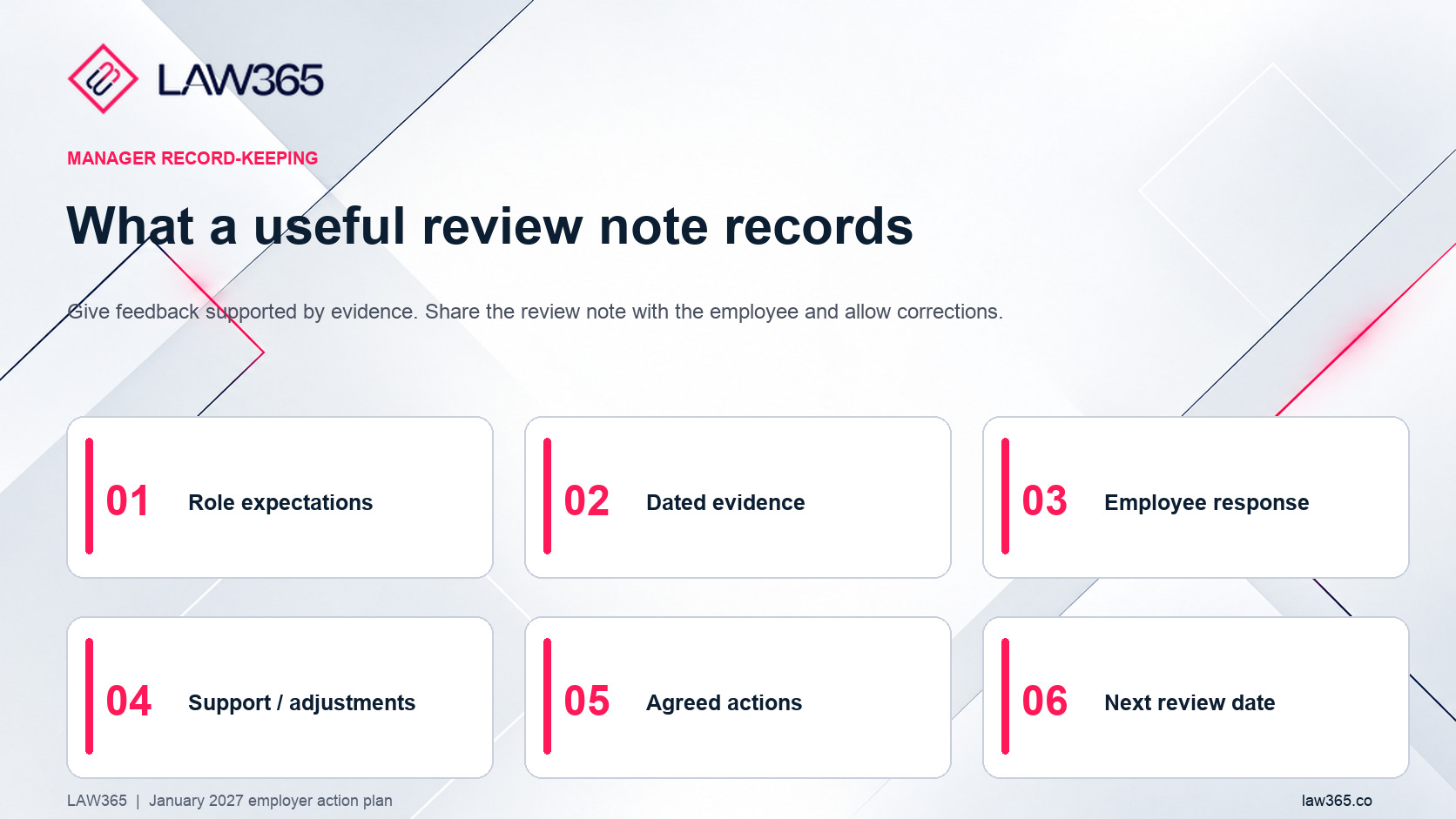
A useful review note records the expectation, dated evidence, the employee's explanation, support or adjustments discussed, agreed action and the next review date. Managers should be sharing the feedback and record with the employee and allow them to raise corrections.
Use probation extensions for a clear purpose
Where an extension is appropriate, check the contractual position and confirm it before the existing probation period ends. Set out the reason, duration, support, review dates and possible outcomes in writing, and discuss the plan with the employee.
An extension can provide a fair opportunity to improve. It does not reset continuous service or delay statutory rights. Absence or family leave should not automatically lead to an extension; consider the circumstances and discrimination risks and whether it is appropriate.
Be aware that six months doesn’t mean six months
Even though employees technically achieve the right not to be unfairly dismissed once they achieve six months service, in practice this occurs prior to their six month anniversary. Employers need to be mindful that statutory notice periods count towards service.
If you therefore wish to dismiss someone on the day before they obtain six months service, they will already have qualified for unfair dismissal. Notice of termination takes effect the day after notice is given, even when termination is with immediate effect. Having to add on a week of statutory notice as well means that effectively, the qualification for unfair dismissal therefore happens just over a week before the six month anniversary. Employers should therefore not rely on a blanket rule to dismiss a week before six months.
The January changeover also matters. Where the effective date of termination is on or after 1 January 2027, the new rules can apply even if notice was given beforehand. Ask for advice on the actual dates and terms before any decision.
Short service has never removed every legal risk. Discrimination, whistleblowing, certain automatically unfair dismissal grounds and contractual rights can already matter. Having six months' service also does not prevent a fair dismissal; the reason and process remain important.
Your next step before the Christmas break
Choose one person to coordinate the review. Collect the documents, identify staff approaching a review or contract end date, book the conversations and brief managers on what to record. Resolve uncertainty with advice before an individual case becomes urgent.
Ask LAW365 to review your employment contracts
Are your existing employment contracts and probation processes ready for January?
LAW365 can review your current employment contracts, offer templates and relevant policies, identify wording that needs attention, and explain how probation, notice and fair procedures should work together. We can also help you plan appropriate changes to existing terms and give managers practical guidance.
Contact LAW365 to discuss an employment contract and probation review. Tell us how many people you employ, the probation periods you use and which documents you would like reviewed. We can agree the scope and next steps with you.
Request an employment contract review
This article provides general information for employers in England, Scotland and Wales. It reflects the position checked on 23 November 2026 and is not advice on an individual employment situation.